What Is an AI Operating System? (And Why Every Business Will Need One)
Most founders using AI are still copy-pasting into ChatGPT and calling it a workflow.
That is not an operating system. That is a smarter notepad.
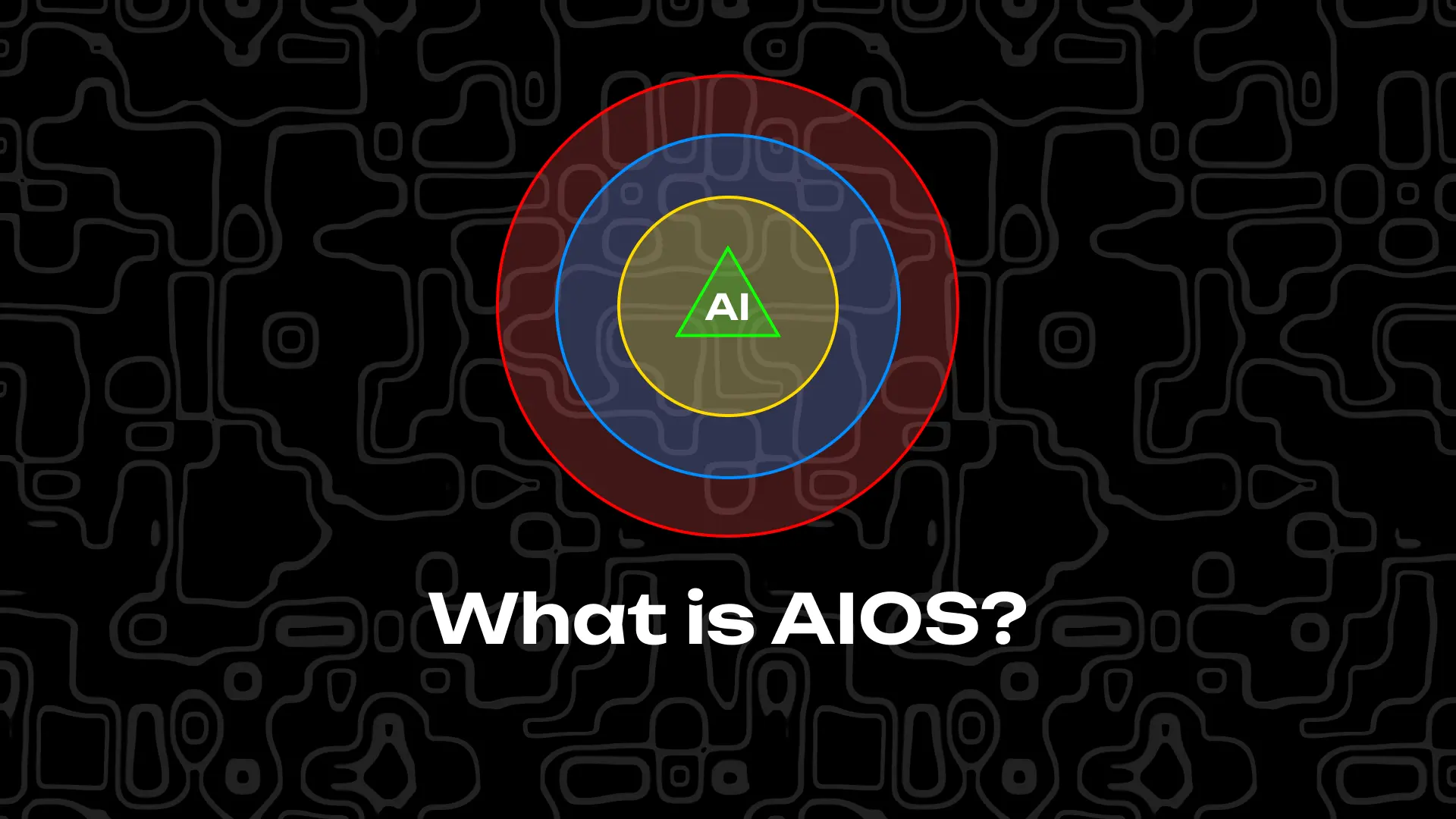
An AI Operating System (AIOS) is something structurally different. It sits around your business model as a persistent, contextualized layer that can automate tasks, augment your work, and brief you on what is happening across your organization without you having to manually pull any of it together.
TL;DR: AIOS is a methodology, not a product. You build it in layers around your existing business model: context, data, intelligence, automation, and build. The goal is to move from 80% time in the business to 80% time on it. The infrastructure can run on Claude Code, OpenClaw, Hermes, or similar agent frameworks, and the KPIs to track are away-from-desk autonomy, task automation percentage, and revenue per employee.
What AIOS is not: It is not ChatGPT. It is not a chatbot you visit in a browser tab. It is not a SaaS tool you subscribe to. It is a workspace you build that knows your business and executes work inside it.
The Core Distinction: Methodology, Not Business Model
AIOS is not what you sell. It wraps around what you sell.
Your business model (agency, ecom, SaaS, info product, whatever) is the core. AIOS is the layer around it. The wrapper starts thin and builds up over time as you add more context, automate more tasks, and connect more data sources. Each layer reduces how much of the business depends on you showing up to manually execute things.
The analogy that holds: most founders spend 80% of their time in the business and 20% on it. The 80% is maintenance. The 20% is where actual growth happens: new channels, new products, new campaigns. AIOS is the mechanism for flipping that ratio. Get the in-the-business work down to 15-20% and redirect the rest toward new initiatives that compound.
That rebalancing is where the real value sits.
The Infrastructure Layer: Claude Code, OpenClaw, and Hermes
The methodology is tool-agnostic, but you need an agent framework as the foundation. Three options worth knowing:
Claude Code is the one most practitioners are building on right now. Do not let the name mislead you. It is not just for developers. The better mental model is: a very smart AI assistant that has full access to a set of files and folders you deliberately build out, can search the web, connect to APIs, run workflows on a schedule, and maintain deep context about your business across every session. More hands-on to set up, but highly customizable.
OpenClaw is an open-source AI agent built for business operations. It connects directly to your tools (inboxes, CRMs, Slack, spreadsheets, project boards) and executes workflows inside your existing stack rather than alongside it. Stronger out of the box for team environments and multi-user setups. Less configuration overhead for standard business workflows.
Hermes is a newer AI agent framework oriented around orchestrating multi-step autonomous workflows. Worth watching if your use case involves complex, multi-stage task chains across many systems.
All three support the same underlying AIOS architecture: a persistent workspace that knows your business, connects to your data, and runs work on your behalf. The right choice depends on your tech comfort level, team size, and which integrations matter most.
Regardless of which you pick, the workspace you build inside it follows the same structure:
- Business context files (who you are, what you sell, your team, your values)
- Strategy documents (quarterly goals, growth targets)
- Connected data sources (Stripe, Google Sheets, ad platforms)
- Repeatable workflow docs (skills)
- Database files for intelligence (meeting transcripts, Slack history)
Every time you open a session, the agent already knows all of that. You never paste "here is what my business does" again.
Skills are the unlock: A skill is a small doc or folder that teaches the agent how to do a specific task the way you want it done. You can build your own or use ones other practitioners share. Once installed, the agent reads the skill before executing, meaning it follows your standards without re-prompting.
The Five Layers of an AIOS
Building an AIOS is not a weekend project and not a single install. It is a layered build. Here is how the layers stack.
Layer 1: Context
The system needs to know your business before it can do anything useful for it.
This means writing out and structuring:
- What your business does and who it serves
- Your products and services
- Your team structure
- Your brand voice and values
- Your quarterly strategy
This is your Context OS. It is the foundation every other layer depends on. A system without this layer will ask the same onboarding questions every session, fail to produce work that sounds like you, and miss the strategic picture when analyzing data.
Layer 2: Data
Once Claude knows your business contextually, you connect the numbers.
Data sources worth connecting early:
- Revenue tracking (Stripe, payment processors)
- Traffic and click data (Google Analytics, Bitly)
- Ad performance (Facebook Ads, Google Ads)
- Spreadsheets with operational metrics
With data connected, you can ask for things like: "Show me the relationship between YouTube posts and revenue over the last 90 days" and get an actual analysis, not a template. The system knows your strategy from Layer 1, so it can situate the data inside that context rather than just reporting isolated numbers.
Layer 3: Intelligence
Intelligence is everything happening across your organization in real time.
For most businesses this means two feeds:
-
Meeting recordings via tools like Fireflies. Every meeting that happens gets logged, transcribed, and stored in a local database Claude can query. You can ask: "What happened across all client calls last week?" and get a structured summary.
-
Team communication via Slack. Pull Slack messages into the same database. Query by person, by date, by channel, by project. Nothing gets lost in a thread you forgot to check.
The payoff for Layers 1-3 combined is the daily brief. A scheduled workflow that runs every morning and produces a 5-10 page PDF (plus a short Telegram summary) covering:
- Revenue and funnel data from the last 24 hours
- Key signals from meetings and Slack across all business streams
- Strategic insights against your stated goals
- Content opportunities, competitive signals, and open items
That brief alone eliminates hours of daily admin most founders grind through manually. It is one of the highest-value first checkpoints in a real AIOS build.
Real output: One AIOS build analyzed 80 calls across 6 different business streams overnight and delivered a full narrative brief by morning. That is work that would have taken a full-time ops person several hours to compile manually.
Layer 4: Automate
With the base in place, the next layer is systematic task removal.
The process starts with a task audit. List every task you are responsible for across every part of your business. Then sort them:
- Which ones follow a repeatable pattern?
- Which ones do not require judgment on your part?
- Which ones consume the most time per week?
Those are the automation targets. Work through them one at a time. For each one, you can use an explore command with your agent (Claude Code has a /explore pattern built for this): "I do this task regularly, and you know my business. Help me figure out how to automate it." The agent searches the web, searches your workspace, and walks you through a viable path.
Once you have structured a task for automation, you set it up on a schedule (cron job). It runs automatically. You stop doing it manually. The bandwidth bar moves.
One well-built AIOS at this layer covers things like:
- Automated reporting across ad platforms and revenue tools
- Lead data structuring and CRM updates
- Content workflow steps (outlines, briefs, repurposing)
- Funnel and page deployment
- Client-facing draft generation with review gates
Layer 5: Build
Bandwidth freed. Now what.
This is the decision point every founder handles differently. Some use the recovered capacity to run the business with less stress and fewer hours. That is a valid outcome.
Others pour it directly into new initiatives: new channels, new products, new markets, things that were sitting on a whiteboard for months because there was never time to execute. This is where compounding starts. The bandwidth plus the workstation means you can compress timelines that used to take months.
The Operator Trap AIOS Is Designed to Solve
There is a failure mode almost every growing business hits. The founder becomes the highest-paid operator in the company. They are executing daily, inside the machine, running tasks that keep things moving but do not grow anything.
New opportunities appear. Competitors move. Markets shift. But the founder has no bandwidth to respond because the machine needs them to run it.
AIOS is a direct structural response to that trap.
The system handles the machine work. That is not aspirational, it is measurable. Practitioners tracking this seriously are reaching 60-70% task automation rates, meaning most of what they used to spend time on is now running without them.
What you do with that is up to you. But at minimum, you get to stop being the most expensive admin in your own company.
Three KPIs to Track
Without specific targets, an AIOS build becomes busywork with no clear progress signal. These three metrics keep it honest.
1. Away-From-Desk Autonomy
Can you run your business from your phone?
The real test: leave your laptop at home for a weekend. Does anything break? What are you unable to handle via Telegram or your mobile interface? Where are the gaps in your away-from-desk setup?
Closing those gaps, one workflow at a time, is the work. The target is 100%: every task you need to do when away from your desk is accessible and executable through your mobile setup.
2. Task Automation Percentage
Start with a count of every task you currently own. Track how many have been automated or heavily augmented over time.
A reasonable 30-day target is 60-70% of identified tasks. Track it like a number, not a vibe.
3. Revenue Per Employee
This is becoming one of the most meaningful metrics in the AI era.
It is not about cutting headcount for its own sake. It is about measuring whether your AI infrastructure is producing real operational leverage. If revenue grows while headcount stays flat, RPE goes up. If revenue stays flat but you run leaner, RPE goes up.
Small businesses have a structural advantage here over large enterprises with legacy ERPs and inflexible tech stacks. The ability to swap tools, connect APIs freely, and build a customized AIOS on top of a nimble stack is a small-business-specific edge that larger competitors cannot easily replicate.
Revenue per employee is the new flex. The businesses that will pull away over the next 2-3 years are not the ones with the most headcount. They are the ones with the highest output per person, driven by an AIOS that carries the operational load.
What Blocks Most Founders From Starting
Two things.
First, the assumption that this requires technical skill. It does not require much. Claude Code can explain setup steps to non-technical users. The skills and context layer can be structured by anyone who can write in plain language. The hardest part is deciding what to build, not building it.
Second, thinking it has to be done all at once. It does not. The whole model is layers and not leaps. Context first. Then data. Then intelligence. Then automation. Each layer adds standalone value before the next one is built. You can get meaningful ROI from Layer 1 and 2 alone before ever building the daily brief or automating a single task.
If you are non-technical, OpenClaw or a pre-configured Claude Desktop setup is the lower-friction entry point. If you want maximum flexibility and are comfortable working in a terminal or IDE, Claude Code gives you more control. Hermes is worth evaluating if orchestration across many external systems is the primary use case.
The important thing is starting and staying sequential.
Bottom Line
AIOS is not hype and not a distant concept. The infrastructure exists right now. Claude Code, OpenClaw, and Hermes are all capable of this today. The methodology is testable in weeks, not months.
The businesses building this now are not just becoming more efficient. They are building a structural advantage that compounds with every layer added, every task automated, every data source connected.
Most of their competitors are still copy-pasting into a chat window.
If you want to map out where an AIOS build would have the most immediate impact in your business, book a strategy call with Systems Department and we will identify the highest-leverage starting point for your specific setup.